
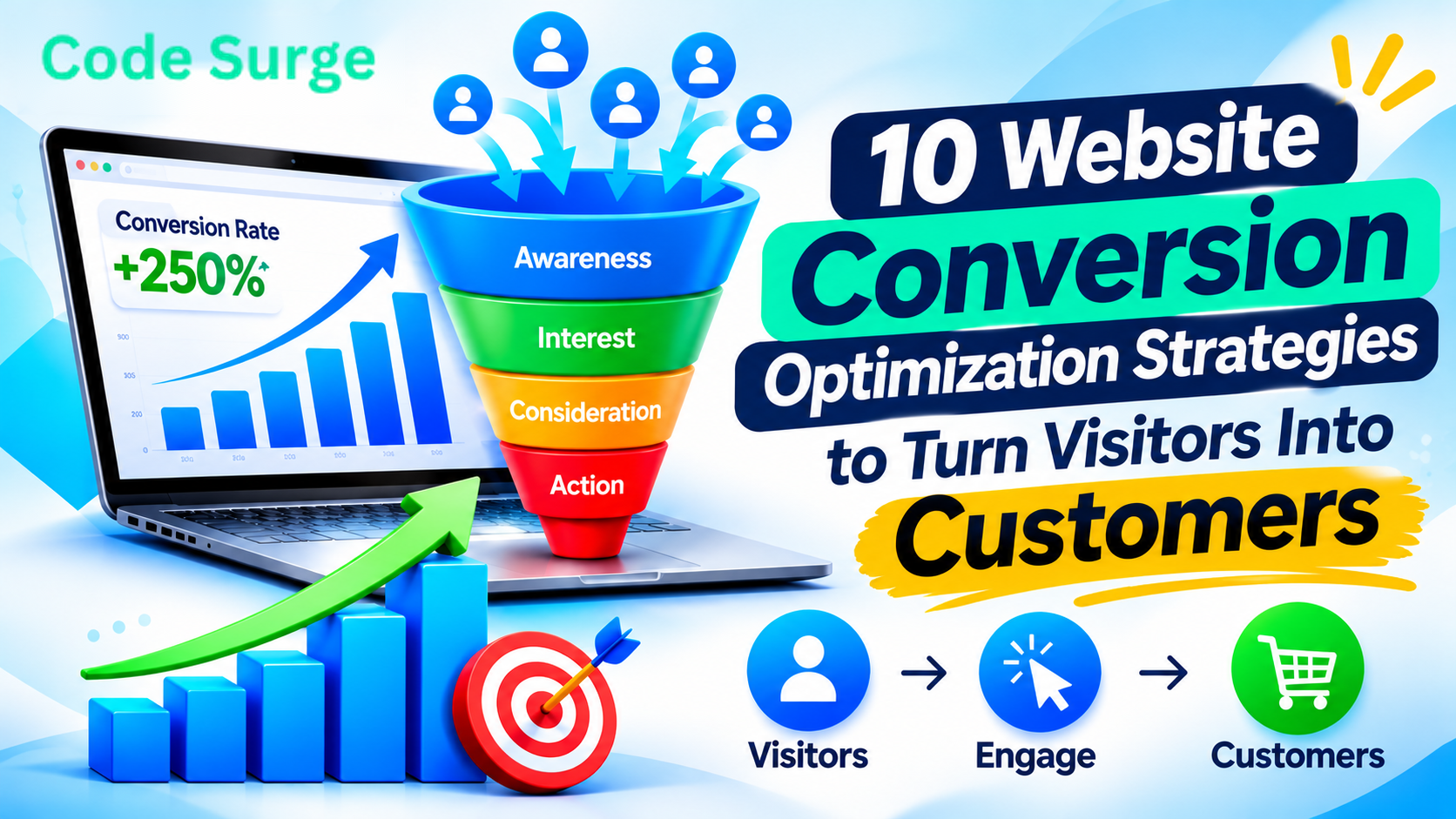
Getting visitors to your website is only the first step. The bigger challenge is turning those visitors into leads, enquiries, sign-ups, bookings, or customers.
A website can receive organic search traffic, paid traffic, social media visitors, and referrals, but if visitors cannot quickly understand what you offer or what they should do next, many of those opportunities can be lost.
This is where conversion rate optimization (CRO) comes in.
Conversion rate optimization is the process of improving a website so that a higher percentage of visitors complete a desired action. Depending on the business, that action could be submitting an enquiry form, requesting a quote, making a purchase, booking a consultation, calling the business, or signing up for a service.
For businesses investing in web development, SEO, digital marketing, and online lead generation, CRO can help turn existing website traffic into more meaningful business results.
In this guide, we explore 10 practical website conversion optimization strategies that businesses can use to improve user experience, increase engagement, and generate more conversions.
What Is Conversion Rate Optimization?
Conversion rate optimization (CRO) is a data-driven approach to improving a website's ability to turn visitors into customers or leads.
For example, if 1,000 people visit a website and 30 submit an enquiry form, the conversion rate is 3%.
A CRO strategy looks at what happens before that conversion:
-
Where are visitors coming from?
-
Which pages do they visit?
-
Where do they leave?
-
Are visitors finding the information they need?
-
Are calls to action clear?
-
Is the website easy to use on mobile devices?
-
Is the enquiry or checkout process too complicated?
-
Does the website clearly communicate why someone should choose the business?
The goal is not simply to increase traffic. It is to make the existing traffic more valuable.
1. Create Clear and Compelling Calls to Action
One of the simplest website conversion optimization strategies is improving your calls to action (CTAs).
A visitor should not have to guess what to do next.
Depending on your business, useful CTAs could include:
-
Request a Quote
-
Contact Us
-
Book a Consultation
-
Get Started
-
Request a Demo
-
Shop Now
-
Get a Free Consultation
-
Talk to an Expert
Your primary CTA should be easy to find and clearly communicate the next step.
Instead of relying on generic buttons such as "Click Here" or "Submit", use action-oriented language that tells visitors what will happen when they click.
For example:
Less specific:
"Submit"
More useful:
"Request a Free Consultation"
The CTA should also be placed naturally throughout important pages rather than appearing only at the bottom.
2. Improve Your Website's Value Proposition
Visitors should understand what your business does and why it matters within seconds of arriving on a page.
Your value proposition should answer three basic questions:
-
What do you offer?
-
Who is it for?
-
Why should the visitor choose you?
A strong value proposition can reduce uncertainty and help visitors decide whether they are in the right place.
For example, a technology company could clearly explain its services, target businesses, development capabilities, and the type of problems it solves.
Avoid filling the first section of a page with complicated technical terminology. Start with the customer's problem and explain how your solution helps.
3. Make Your Website Mobile-Friendly
A large percentage of website visitors use smartphones, making mobile experience an important part of conversion rate optimization.
A website may look excellent on a desktop but still create conversion problems on smaller screens.
Check whether:
-
Text is easy to read
-
Buttons are large enough to tap
-
Forms work correctly
-
Navigation is simple
-
Images scale properly
-
Important information is visible without excessive scrolling
-
Pages load efficiently
-
Contact options are easy to access
Mobile optimization is also important from an SEO perspective. Google recommends providing a good page experience across devices, including mobile usability and strong overall page experience.
4. Simplify Contact and Lead Generation Forms
Long or complicated forms can discourage potential customers from completing an enquiry.
If you only need a visitor's name, email address, phone number, and enquiry, avoid asking for unnecessary information at the first stage.
Consider testing:
-
Fewer form fields
-
Clear field labels
-
Helpful error messages
-
A prominent submit button
-
Mobile-friendly forms
-
Short explanations about what happens after submission
For service businesses, the objective is to make contacting the company feel simple and low-risk.
You can collect additional information later when it is genuinely needed.
5. Improve Website Speed and Page Experience
A slow website can negatively affect the user experience before a visitor even reads your content.
People expect websites to load quickly and respond smoothly, particularly when browsing from mobile devices.
Review:
-
Page loading performance
-
Image sizes
-
JavaScript and CSS
-
Server response time
-
Third-party scripts
-
Mobile performance
-
Core Web Vitals
-
Cumulative layout shifts
-
Interaction responsiveness
Website performance should not be treated as a separate technical issue from CRO. If visitors struggle to use a website, they may leave before reaching a conversion point.
Google's page experience guidance also recommends looking at Core Web Vitals, mobile usability, HTTPS, intrusive elements, and the overall experience of the page.
6. Build Trust With Reviews, Testimonials and Proof
Visitors are more likely to contact a business when they feel confident about the company.
Trust signals can include:
-
Customer reviews
-
Testimonials
-
Case studies
-
Client logos
-
Certifications
-
Industry experience
-
Awards
-
Project results
-
Before-and-after examples
-
Security information
-
Clear company details
For a service-based business, showing what you have actually delivered can be more persuasive than simply saying that you are an experienced company.
Where possible, use genuine customer experiences and measurable results.
7. Create Dedicated Landing Pages for Different Services
Sending every visitor to the homepage is not always the best conversion strategy.
If someone searches for a specific service, they should ideally arrive on a page that directly addresses that service and their potential needs.
For example, a technology company may have separate pages for:
-
Web development
-
E-commerce development
-
Mobile app development
-
SEO
-
UI/UX design
-
IT consulting
-
Conversion optimization
Each service page can target a specific search intent while providing a clear path toward contacting the business.
This also creates a stronger internal linking structure across the website.
For businesses looking to improve their website's ability to generate leads, Code Surge provides dedicated conversion optimization services focused on improving the journey from visitor to conversion.
8. Use Analytics to Understand Visitor Behaviour
Effective CRO should be based on data rather than assumptions.
Tools such as Google Analytics and Google Search Console can help businesses understand how users discover and interact with their websites.
Look at metrics such as:
-
Organic traffic
-
Landing pages
-
Engagement
-
Conversion events
-
Form submissions
-
Click-through rates
-
Traffic sources
-
Device performance
-
User journeys
For example, if a service page receives significant organic traffic but generates very few enquiries, that page could be a strong candidate for conversion optimization.
Similarly, if mobile users have significantly lower engagement or conversion rates than desktop users, the mobile experience deserves closer investigation.
9. Test Different Website Elements
CRO is not about making one change and assuming it will work.
Testing can help businesses understand which changes actually improve performance.
You can test elements such as:
-
Headlines
-
CTA wording
-
Button placement
-
Images
-
Form length
-
Page layouts
-
Testimonials
-
Pricing presentation
-
Landing page structure
-
Navigation
For example, you could compare two versions of a CTA:
Version A: "Contact Us"
Version B: "Request a Free Consultation"
The important part is measuring the results rather than relying on personal preference.
Over time, these tests can provide useful insights into what your audience responds to.
10. Connect SEO and Conversion Optimization
SEO and CRO should not operate separately.
SEO helps bring relevant visitors to your website. CRO helps your website turn those visitors into business opportunities.
A website can rank well for valuable keywords but still generate poor business results if the landing page does not satisfy search intent or provide a clear next step.
For example, someone searching for "web development company in Sri Lanka" is likely looking for more than a general explanation of web development.
They may want to know:
-
What services are available?
-
What technologies are used?
-
Does the company have relevant experience?
-
What types of businesses does it work with?
-
How can they request a quote?
-
How can they contact the company?
This is why SEO-friendly content should also be useful for real customers.
Google's current guidance for AI features reinforces this approach: websites should focus on helpful, reliable, people-first content and make important content easy for search systems to discover through a clear technical structure and internal links.
How Conversion Optimization Supports SEO and AI Search Visibility
Modern search is no longer limited to traditional blue-link results. Google Search now includes AI-powered experiences such as AI Overviews and AI Mode.
However, there is no separate "AI SEO trick" that guarantees visibility.
Google states that the same foundational SEO practices remain important for generative AI search. Pages need to be crawlable and indexable, important information should be available in text, internal links should help discovery, and the content should provide useful information that goes beyond generic summaries.
For businesses, this means your website should be built around genuine user needs.
A strong conversion-focused page should clearly explain:
-
What the business does
-
Which problems it solves
-
Who it helps
-
What services are available
-
Why the business is credible
-
What customers can expect
-
How visitors can take the next step
This structure can help both users and search systems understand the purpose and relevance of the page.
Common CRO Mistakes Businesses Should Avoid
While improving conversion rates, avoid making changes simply because they seem popular.
Common mistakes include:
Too Many CTAs
Giving visitors too many competing actions can make the next step unclear.
Overloaded Pages
Adding excessive text, pop-ups, banners and design elements can distract visitors from the main purpose of the page.
Generic Content
Copying the same generic service descriptions found across competitors does not give users a strong reason to choose your business.
Ignoring Mobile Users
A desktop-first experience can create unnecessary friction for smartphone users.
Making Decisions Without Data
Not every design change improves conversions. Use analytics, testing and user behaviour to support your decisions.
Focusing Only on Traffic
More traffic does not automatically mean more customers. Traffic quality and the experience after the click also matter.
How to Build a Conversion-Focused Website
Conversion optimization works best when it is considered during the entire website development process rather than added as an afterthought.
That means combining:
SEO + UX + web development + analytics + content + conversion strategy
A well-structured website should attract the right audience, answer their questions, build trust and make it easy for them to take action.
If you are planning a new website or improving an existing one, you can explore Code Surge's services to see how its technology and digital solutions can support your business.
You can also learn more about the company through its About Code Surge page and explore its technology and development capabilities.
For businesses looking for professional assistance with improving website conversions, visit the Conversion Optimization service page or contact Code Surge to discuss your requirements.
Final Thoughts
Increasing website traffic is important, but traffic alone does not generate business growth.
A successful website should guide visitors from their first interaction to a clear and simple next step.
By improving your calls to action, value proposition, mobile experience, forms, website speed, trust signals, landing pages, analytics and testing process, you can create a website that is better positioned to turn relevant visitors into leads and customers.
The most effective conversion rate optimization strategy is not about making a website look better for the sake of design. It is about understanding your visitors, identifying friction points and continuously improving the experience based on real data.
For businesses in Sri Lanka and beyond, combining SEO, web development, user experience and conversion optimization can create a stronger foundation for sustainable digital growth.
Frequently Asked Questions About Conversion Rate Optimization
What is conversion rate optimization?
Conversion rate optimization (CRO) is the process of improving a website or landing page so that a higher percentage of visitors complete a desired action, such as submitting a form, making a purchase or contacting a business.
Why is conversion rate optimization important?
CRO helps businesses get more value from their existing website traffic. Instead of focusing only on attracting more visitors, businesses can improve the percentage of visitors who become leads or customers.
How can I improve my website conversion rate?
Start by reviewing your value proposition, calls to action, forms, mobile experience, page speed, trust signals and user behaviour data. Testing different page elements can then help identify which changes improve conversion performance.
Is CRO part of SEO?
CRO and SEO are different disciplines, but they work well together. SEO focuses on attracting relevant organic search traffic, while CRO focuses on improving the percentage of visitors who take valuable actions on the website.
Does website speed affect conversions?
Website speed can affect user experience and engagement. A slow or difficult-to-use website can create friction and cause visitors to leave before completing an important action.
How can Code Surge help with conversion optimization?
Code Surge provides conversion optimization services designed to help businesses improve website performance and turn more website visitors into meaningful enquiries and conversions. Businesses can review the Code Surge Conversion Optimization service or contact the team to discuss their requirements.