
Businesses today rely on websites and web applications for far more than simply displaying information. From e-commerce platforms and customer portals to booking systems, payment integrations and business management tools, modern digital products need to be fast, secure, scalable and easy to use.
This is where full stack development becomes important.
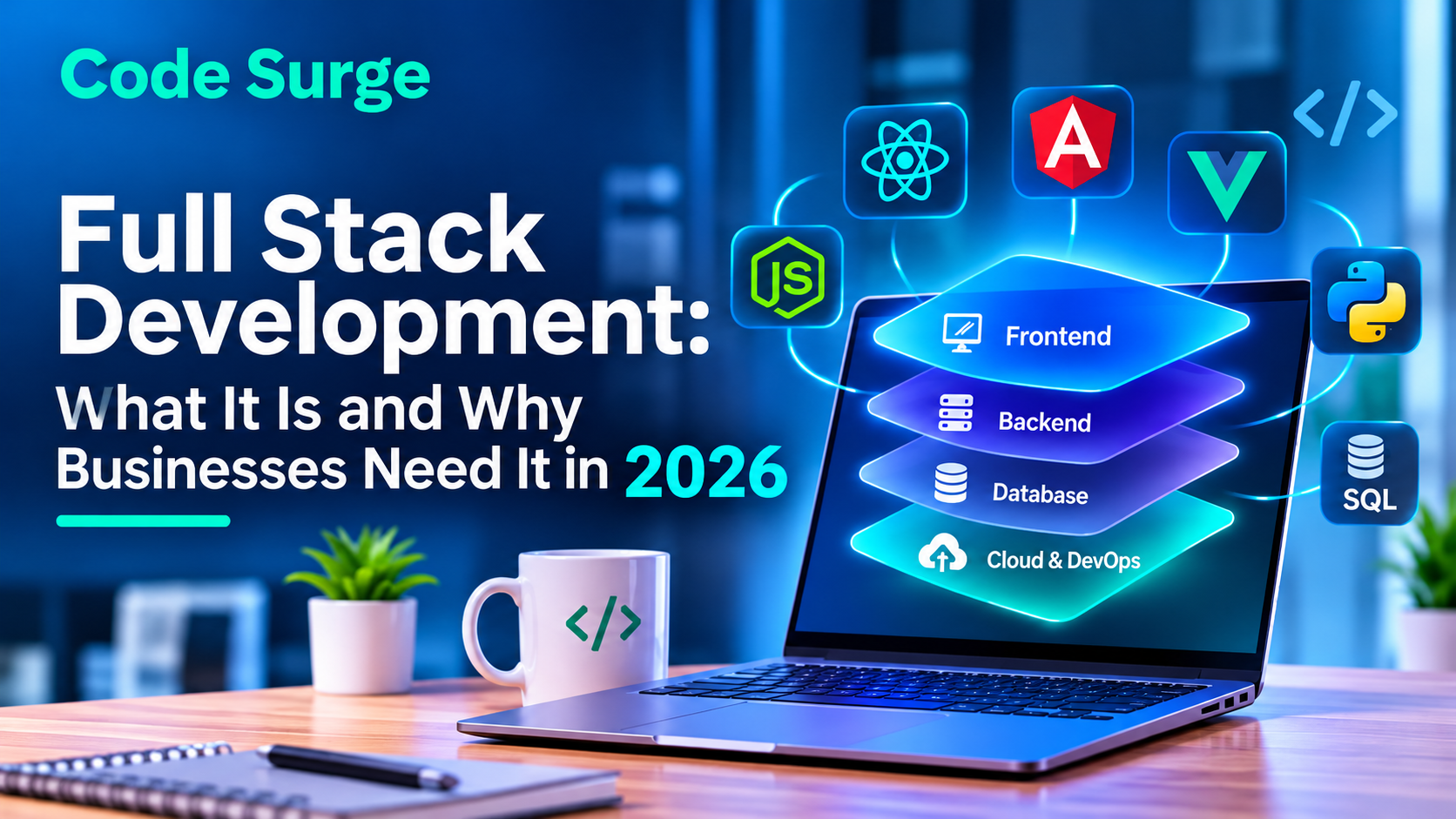
Full stack development brings together the different layers of a digital product, including the frontend that users interact with, the backend that powers the application, databases, APIs, integrations, security and cloud infrastructure.
For businesses planning a new digital product or modernizing an existing system, understanding how full stack web development works can help when choosing the right technology and development approach.
What Is Full Stack Development?
Full stack development is the process of developing both the frontend and backend components of a website or web application.
The frontend is the part users see and interact with. It includes elements such as navigation, forms, dashboards, product pages, buttons, animations and other interface components.
The backend works behind the scenes. It manages business logic, databases, authentication, APIs, server-side processes and communication between different systems.
A full stack development approach connects these layers into one complete digital solution.
In simple terms:
Frontend → Backend → Database → APIs → Infrastructure
All of these components need to work together to provide a reliable user experience.
For businesses, this means full stack development can support everything from a relatively simple business website to a complex SaaS platform, e-commerce application or custom business management system.
What Does a Full Stack Developer Do?
A full stack developer works across multiple layers of an application rather than focusing on only one area of development.
Depending on the project, their responsibilities may include:
-
Building responsive frontend interfaces
-
Developing backend applications and business logic
-
Designing and managing databases
-
Creating and integrating APIs
-
Implementing user authentication
-
Connecting third-party services
-
Improving website and application performance
-
Testing frontend and backend functionality
-
Supporting cloud deployment and infrastructure
-
Identifying and fixing technical issues
-
Improving application security and scalability
The exact responsibilities depend on the size and complexity of the project.
For larger applications, full stack development may involve a wider engineering team where specialists work together across frontend, backend, DevOps, database and security areas.
Frontend vs Backend Development
Understanding the difference between frontend and backend development makes it easier to understand full stack development.
Frontend Development
Frontend development focuses on the user-facing side of a website or application.
Common frontend technologies include:
-
HTML
-
CSS
-
JavaScript
-
React
-
Vue.js
-
TypeScript
The goal is to create interfaces that are responsive, accessible, intuitive and fast.
A well-developed frontend should work smoothly across desktops, tablets and mobile devices while providing a clear user journey.
Backend Development
Backend development focuses on the systems and logic that power an application.
Backend development can involve:
-
Server-side programming
-
APIs
-
Database architecture
-
Authentication
-
Business logic
-
Data processing
-
Security
-
Server-side rendering
Technologies such as Node.js, Python and Go can be used to build backend systems depending on the project requirements.
Database Development
Applications need reliable ways to store and retrieve information.
Depending on the project, developers may use relational databases such as PostgreSQL or NoSQL databases such as MongoDB.
Database architecture is particularly important for applications that handle large amounts of customer, product, transaction or operational data.
Why Do Businesses Need Full Stack Development in 2026?
The requirements of modern digital businesses have changed.
A website may now need to connect with payment gateways, customer relationship management systems, analytics platforms, marketing automation tools, inventory systems, mobile applications and cloud infrastructure.
A disconnected approach can make these systems more difficult to manage.
A well-planned full stack development solution can bring the different components together.
1. Better Integration Between Systems
Modern businesses rarely operate with a website alone.
They may use:
-
CRM platforms
-
Payment gateways
-
ERP systems
-
Marketing automation
-
Shipping platforms
-
Customer portals
-
Analytics tools
-
AI-powered applications
-
Internal business systems
APIs allow these systems to communicate with each other.
Full stack development can help businesses design and manage these integrations as part of a broader application architecture.
2. Scalable Web Applications
A business application needs to support its current users while allowing room for future growth.
A scalable architecture can help an application handle increasing traffic, users and data without requiring the entire system to be rebuilt.
This is particularly important for:
-
SaaS businesses
-
E-commerce platforms
-
Financial applications
-
Customer portals
-
Online marketplaces
-
Booking platforms
-
Business management systems
Cloud infrastructure and automated scaling can also support applications as demand changes.
3. Improved Website and Application Performance
Performance affects both user experience and business outcomes.
Slow pages can make it harder for users to complete important actions such as submitting a form, purchasing a product or navigating an application.
Full stack development allows performance to be considered across multiple layers, including:
-
Frontend code
-
Database queries
-
API responses
-
Server configuration
-
Caching
-
Cloud infrastructure
-
Image and asset delivery
Server-side rendering and appropriate caching strategies can also contribute to better performance and search-friendly web applications.
4. Stronger Security
Security needs to be considered throughout the development process rather than added at the end.
Depending on the application, security measures can include:
-
Secure authentication
-
Authorization controls
-
Data encryption
-
Input validation
-
Database protection
-
Secure API design
-
Session management
-
Regular security testing
For businesses handling customer information, financial transactions or other sensitive data, application security should be part of the architecture from the beginning.
5. Easier Long-Term Development
Technology changes quickly.
A business may start with a simple application and later need additional features, integrations or infrastructure.
A modular and well-structured codebase can make future development easier.
For example, a business might initially launch a web application and later add:
-
Mobile applications
-
Customer dashboards
-
New payment methods
-
AI-powered features
-
Third-party integrations
-
Advanced reporting
-
Automated workflows
A scalable architecture can make these changes easier to manage.
What Technologies Are Used in Full Stack Development?
There is no single technology stack that is suitable for every business.
The technology selection should depend on factors such as the application requirements, expected traffic, security requirements, development resources and long-term goals.
A modern full stack development project may use technologies such as:
Frontend
-
React.js
-
Vue.js
-
TypeScript
-
JavaScript
Backend
-
Node.js
-
Python
-
Go
Databases
-
PostgreSQL
-
MongoDB
-
Redis
Cloud & Infrastructure
-
AWS
-
Google Cloud
-
Microsoft Azure
-
CI/CD pipelines
-
Automated scaling
APIs & Integration
-
REST APIs
-
GraphQL
-
Third-party APIs
-
Payment integrations
-
CRM integrations
Code Surge's current full stack development offering covers frontend engineering, backend and database management, API and third-party integrations, and cloud infrastructure. Its technology stack includes React, Vue, TypeScript, Node.js, Python, Go, PostgreSQL, MongoDB and Redis.
Full Stack Development for Different Types of Businesses
Full stack web development can be applied across different industries and business models.
E-commerce Businesses
E-commerce platforms need more than attractive product pages.
They may require:
-
Product management
-
Shopping carts
-
Secure checkout
-
Payment gateway integration
-
Customer accounts
-
Inventory management
-
Order processing
-
Analytics
A full stack architecture can connect these components into one system.
SaaS Businesses
Software-as-a-Service platforms often require user authentication, subscription management, dashboards, databases, APIs and scalable cloud infrastructure.
Full stack development can support these interconnected requirements.
Financial Technology
FinTech applications can require secure authentication, transaction processing, data management, API integrations and strong security controls.
The architecture needs to be designed around the application's specific regulatory and security requirements.
Service Businesses
Service-based companies may use custom web applications for:
-
Appointment booking
-
Customer portals
-
Lead management
-
Online payments
-
Internal workflows
-
Reporting
-
Automated communication
Custom full stack development can connect these processes instead of relying on disconnected systems.
Custom Software Development vs Ready-Made Platforms
Businesses often have to decide whether to use an existing platform or build a custom application.
Ready-made platforms can be useful when a business has relatively standard requirements and wants to launch quickly.
Custom software development can make more sense when a business needs specific workflows, integrations or functionality that existing platforms cannot provide efficiently.
The decision should be based on the actual business requirements, budget, technical resources and long-term plans.
A custom solution should not be built simply because it is technically possible. The technology should solve a genuine business problem.
What Should You Look for in a Full Stack Development Company?
Choosing a full stack development company involves more than checking which programming languages they use.
Consider whether the development team can understand:
Business Requirements
Developers should understand what the application needs to achieve for the business and its users.
Technical Architecture
The team should be able to explain how the frontend, backend, database, APIs and infrastructure will work together.
Security
Ask how authentication, authorization, data protection and application security will be handled.
Scalability
Consider how the application can accommodate future users, data and functionality.
Testing
A development process should include appropriate testing before deployment.
Maintenance
Web applications require ongoing updates, monitoring, bug fixes and improvements after launch.
Communication
Clear communication between the development team and the client is important throughout planning, development, testing and deployment.
How Does a Full Stack Development Project Work?
A structured development process can reduce technical problems later in the project.
A typical workflow may include:
1. Requirements & Architecture
The development team identifies business requirements, user journeys, technical requirements and the overall system architecture.
2. UI/UX & Technical Planning
The user experience and technical structure are planned before development begins.
3. Development
Frontend, backend, database and integration components are developed according to the project architecture.
4. Testing
The application is tested for functionality, performance, security and compatibility.
5. Deployment
The application is deployed to the appropriate hosting or cloud environment.
6. Monitoring & Optimization
After launch, performance, security and user feedback can be monitored to identify areas for improvement.
Code Surge describes its development workflow around requirement architecture, Agile sprint development, end-to-end testing, and deployment and optimization.
Why Choose a Full Stack Development Company in Sri Lanka?
Sri Lanka has an established technology and software development sector serving both local and international businesses.
For a Sri Lankan business, working with a local development team can make communication, requirements gathering, meetings and ongoing support more convenient.
At the same time, businesses should evaluate a development company's experience, technical capabilities, portfolio, communication process and ability to support the project after launch rather than choosing solely based on location.
Code Surge states that it works with both local businesses and global enterprises and provides technology services across areas including full stack development, web development, e-commerce development, cloud enablement, mobile applications and IT consulting.
Frequently Asked Questions About Full Stack Development
What is full stack development?
Full stack development involves developing multiple layers of a web application, including the frontend, backend, database, APIs and supporting infrastructure.
What is the difference between full stack and web development?
Web development is a broad term covering the development of websites and web applications. Full stack development specifically refers to working across both frontend and backend components and, depending on the project, databases, APIs and infrastructure.
What does a full stack developer do?
A full stack developer can work across frontend interfaces, backend systems, databases, APIs and application integrations. Their exact responsibilities depend on the project and development team.
Is full stack development suitable for small businesses?
It can be. The appropriate development approach depends on the business requirements. A small business may need only a simple website, while another may require a custom application with databases, integrations and automated workflows.
How much does full stack development cost in Sri Lanka?
There is no single fixed price. The cost depends on factors such as project complexity, number of features, technology stack, integrations, design requirements, security requirements and development time. A proper project assessment is needed before providing an accurate estimate.
How long does it take to build a full stack application?
Development time varies significantly depending on the application's complexity. A basic application may require substantially less development time than a large platform involving multiple integrations, user roles, payment systems and complex business logic.
Why is API development important in full stack applications?
APIs allow different software systems to communicate with each other. They can connect a web application with payment gateways, CRMs, third-party services, mobile applications and other business systems.
Build a Scalable Digital Product With the Right Technology
Full stack development is not simply about combining frontend and backend programming.
For businesses, it is about building a digital system where the user interface, application logic, database, integrations, security and infrastructure work together.
Whether you are launching a new web application, improving an existing platform or replacing a legacy system, the right architecture can make it easier to improve performance, add functionality and scale as your business grows.
If you are exploring full stack development services in Sri Lanka, the next step is to clearly define your business requirements, technical needs and long-term goals before selecting a development approach.
Learn more about Code Surge, explore the company's technology solutions, or visit the Full Stack Development service page to see how its development team approaches end-to-end web solutions.
You can also learn more About Code Surge, explore other resources through the Code Surge blog, or contact the team to discuss your project requirements.